Idealism beyond Borders charts the course of two activist movements in France, tiers-mondiste and sans-frontiériste, and the process by which one came to displace the other as the dominant way of approaching suffering and injustice in the “third world”. It demonstrates how and why the sans-frontiériste movement, before it refashioned international diplomacy, attracted the attention of many of France’s most prestigious intellectuals and influential publications.
The tiers-mondiste (third-worldist) belief in third-world revolution developed at a time when the left-wing landscape in Europe looked barren and the Soviet one hostile. The fascination with the revolutions in Algeria, Cuba, China, and Vietnam, to name only the most arresting examples, manifested itself in theoretical, literary, and cultural forms. Yet revolutionary zeal disintegrated as third-world regimes showed their dictatorial and bloodthirsty colours.
At this time, the radical humanitarian model of sans-frontiérisme – which took its name from the pioneering organisation Médecins Sans Frontières – emerged as an alternative model for engagement with events in the third world. Its success has seen MSF become one of the top five humanitarian organisations worldwide in terms of budget and reach. The ‘Without Borders’ ethos and epithet gained traction in France and abroad, influencing a generation of humanitarian organisations and global debates about humanitarianism and human rights.
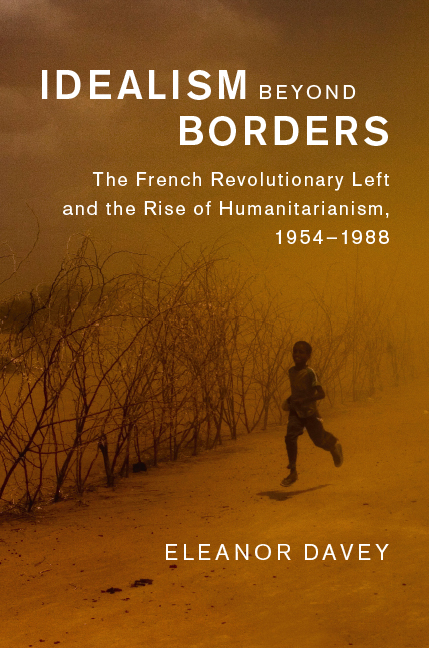
Idealism beyond Borders is a contribution to the historiography of the post-war transformation of the French intellectual and political landscape and sheds light upon the intellectual origins and evolution of modern French humanitarianism. Published by Cambridge University Press in December 2015, it was joint recipient of the International Studies Association Ethics Section Book Prize in 2017. A paperback version came out in 2018. I have also published two related articles – if you cannot access them and would like to, please get in touch.
“French adventures in solidarity: revolutionary tourists and radical humanitarians,” European Review of History 21:4 (October 2014): 577-95. doi: 10.1080/13507486.2014.933189.
“Famine, aid, and ideology: the political activism of Médecins Sans Frontières in the 1980s,” French Historical Studies 34:3 (Summer 2011): 529-58. doi: 10.1215/00161071-1259157.
“This subtle portrayal of complex debates shaped by the Cold War and decolonisation is conceptually sophisticated, subtle in its analysis, and beautifully written. It is a formidable contribution to the history of the second half of the twentieth century.”
—Robert Gildea, University of Oxford
“Davey has encapsulated a history that seems almost inherently hostile to scholarly narrative with clarity and remarkable parsimony.” —Roland Burke in Human Rights Quarterly
“Eleanor Davey’s book makes enjoyable reading, with its caustic and forceful view of the pedigree of ‘sans-frontiérisme’, mapping an intellectual landscape which spreads beyond the borders of France and which is still to a large extent ours to this day.”—Frédéric Thomas in Humanitarian Alternatives
 Eleanor Davey